Digital Product Passport: Which Sectors Will Be Affected First and What Comes Next

In the previous publications in the information series of the Ruse Chamber of Commerce and Industry, we presented the core concept of the Digital Product Passport, the regulatory framework, and the importance of reliable product data. The next key question for businesses is which product groups will be covered first and how the future requirements may affect companies across different sectors.
The Digital Product Passport will not be introduced simultaneously for all products. The European approach provides for the gradual adoption of rules for individual product groups. The specific content of the passport, the responsibilities of economic operators, access rights, and implementation timelines will be determined through delegated acts under the Ecodesign for Sustainable Products Regulation (ESPR) or through separate sector-specific legislation.
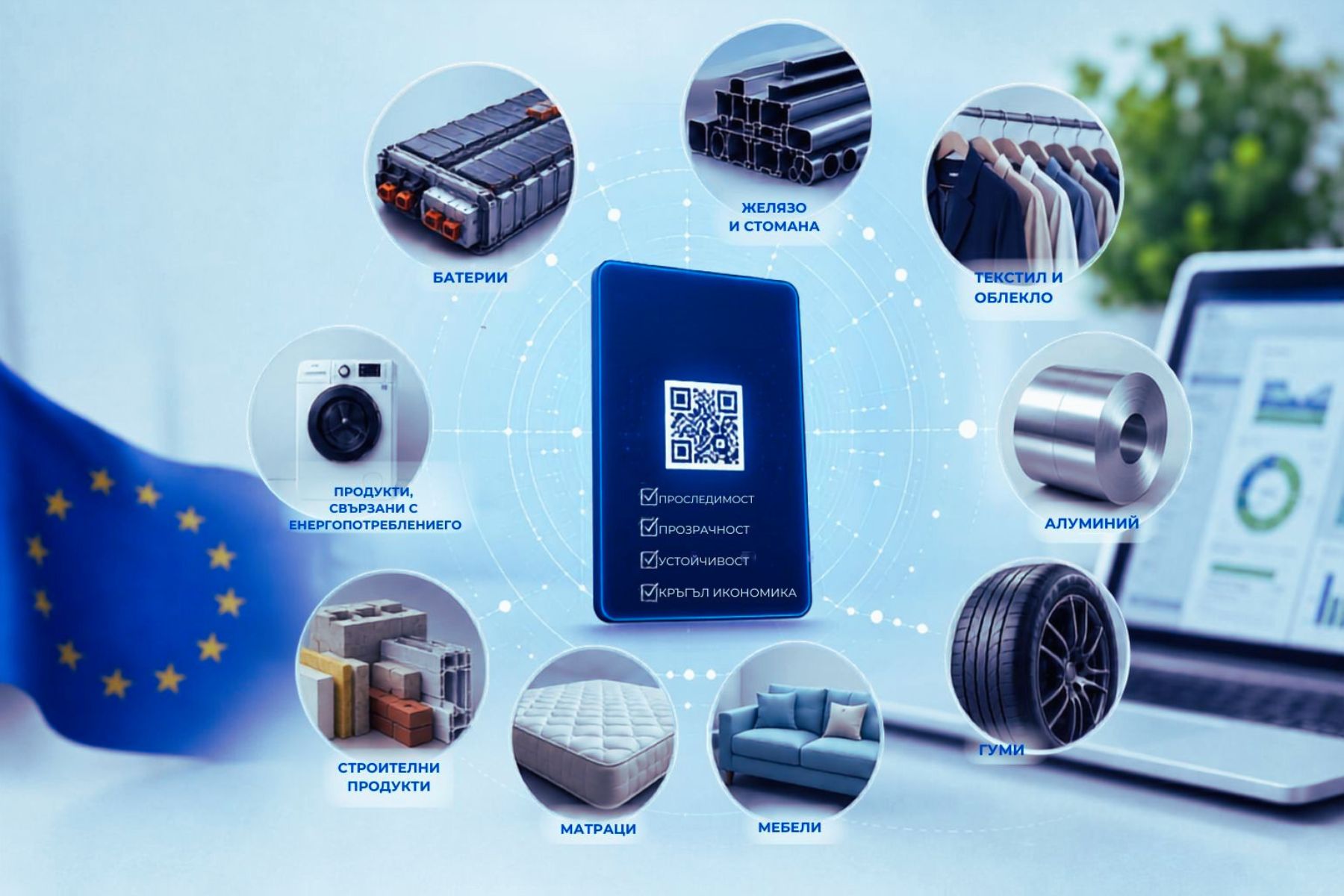
Among the first areas are certain types of batteries, iron and steel, and textile apparel. These are expected to be followed by requirements for aluminium, tyres, furniture, mattresses, construction products, energy-related products, and certain information and communication technology products.
Why Certain Sectors Have Been Prioritised
The priority product groups have been selected based on their potential to improve resource efficiency, durability, repairability, reusability, recyclability, and access to reliable information throughout the value chain.
They include both final consumer products, such as textiles, furniture, mattresses, and tyres, and key industrial materials such as iron, steel, and aluminium. This is important because requirements relating to intermediate materials may affect numerous downstream industries, including automotive manufacturing, mechanical engineering, construction, electronics, and furniture manufacturing.
For businesses, this means that the impact of the DPP will not be limited solely to manufacturers of final products. Importers, distributors, retailers, suppliers of materials and components, service companies, reuse and recycling operators, as well as companies participating in international supply chains may also be affected.
Batteries: The First Product Group with a Defined Deadline
Certain types of batteries are the first product group for which the Digital Product Passport will become mandatory in the European Union. The requirement stems from Regulation (EU) 2023/1542 concerning batteries and waste batteries and uses the common technical framework for DPP established through the ESPR.
From 18 February 2027, a battery passport will be required for electric vehicle batteries, batteries for light means of transport such as electric bicycles, mopeds, and scooters, as well as industrial batteries with a capacity exceeding 2 kWh. Batteries used in residential energy storage systems may also fall within the scope.
Responsibility for creating and maintaining the passport will rest with the economic operator placing the finished battery on the EU market, rather than with suppliers of individual cells, modules, or other components. This distinction is important for companies that integrate batteries into larger systems or offer complete solutions on the European market.
The passport may include identification and technical characteristics of the battery, information about the manufacturer and the responsible economic operator, performance and durability indicators, as well as information related to repair, reuse, recycling, sustainability, and circularity. The exact scope depends on the battery category and the applicable provisions.
For Bulgarian companies, the topic is relevant not only to the manufacture or import of batteries. It may also affect businesses offering electric vehicles, charging and energy solutions, industrial equipment, energy storage systems, or products in which the battery is a significant functional component.
Iron and Steel: Impact Across the Entire Industrial Value Chain
Iron and steel are among the priority product groups included in the ESPR Working Plan. The future requirements will be defined through a specific delegated act, which is provisionally scheduled for adoption in the fourth quarter of 2026.
Steel is an intermediate product used in the manufacture of numerous other products. It is widely used in automotive manufacturing, construction, mechanical engineering, industrial equipment, and many other sectors. Consequently, the introduction of a DPP for iron and steel may affect not only metallurgical companies but also manufacturers that use metal materials and components in their products.
Depending on the final rules, the passport may contain data on product identification and classification, technical and material characteristics, recycled content, sustainability-related indicators, as well as documentation required to demonstrate compliance and traceability.
The obligations may apply to manufacturers, importers, and other economic operators placing covered products on the EU market. Processors, recycling companies, downstream manufacturers, and public authorities may also be granted access to certain data, in accordance with the access rights to be defined in the delegated act.
For companies further down the value chain, this may result in an increasing need for reliable information about the metal materials they use, including their origin, technical properties, recycled content, and supporting documentation.
Textiles and Apparel: Greater Transparency on Materials and the Product Life Cycle
Textile apparel is among the priority groups for the introduction of ecodesign and Digital Product Passport requirements. The relevant delegated act is planned for adoption in the fourth quarter of 2027, after which additional technical guidance and implementation measures are expected to be developed.
The European Commission notes that the textile sector plays a significant role in European value chains, while textile consumption is also among the activities with a substantial impact on the environment, climate, water resources, and land use. Apparel represents the largest textile subgroup by consumption volume in the EU, which is one of the reasons why the sector has been identified as an early priority.
The Digital Product Passport for textile apparel is expected to make product information more accessible and comparable throughout the product life cycle. This may enable companies to provide verifiable information about the sustainability and circularity of their products, while allowing consumers to make more informed choices. The data may also support activities related to repair, reuse, resale, and recycling.
Depending on the final requirements, the passport may include:
- product identification and characteristics;
- fibre composition;
- information on use, repair and maintenance;
- data on reuse, resale, disassembly and refurbishment;
- information on end-of-life treatment and recycling;
- origin data;
- identification of the relevant economic operators;
- compliance and traceability documentation.
The passport should be accessible both through a data carrier placed on the product, such as a QR code, and in online sales. The main obligations will apply to economic operators that place textile products on the market or put them into service in the EU. Depending on the specific business model, these may include manufacturers, contract manufacturers, or importers.
Distributors and retailers will need to ensure that the passport is available for the products they offer. Suppliers of materials, products, or services may also be required to provide information available to them. This is particularly relevant for Bulgarian companies working as subcontractors for international brands or participating in cross-border supply chains.
Aluminum
Aluminum is among the product groups for which the European Commission plans to adopt sectoral requirements in the third or fourth quarter of 2027. Like steel, it is an intermediate material with widespread applications in automotive, construction, electrical engineering, mechanical engineering, packaging and consumer goods manufacturing.
At present, detailed sector-specific guidance comparable to that available for batteries, steel, and textile apparel has not yet been published. The exact product categories, data requirements, and responsibilities are expected to be defined in the future delegated act.
For companies that process or use aluminium, it is important to monitor the development of the requirements, as information on material characteristics, origin, recycled content, and compliance may gradually become increasingly important within supply chains.
Tyres
Sector-specific requirements for tyres are also planned for the third or fourth quarter of 2027. The precise scope of the products and data will be determined through a delegated act under the ESPR.
The requirements may affect manufacturers, importers, distributors, and retailers, as well as companies working with specialised tyres for transport, industrial, agricultural, or other applications.
In the future, information on product identification and characteristics, materials used, performance indicators, recycled content, and end-of-life treatment options may become relevant. These categories should be regarded as indicative until the final sector-specific rules are adopted.
Furniture
The adoption of sector-specific requirements for furniture is provisionally planned for 2028.
Furniture typically combines different materials and components, such as wood, panels, metal, plastics, textiles, fillings, adhesives, and coatings. This makes the traceability of composition and origin more complex and may require information to be collected from multiple suppliers.
Depending on the future rules, relevant data may include information about the materials used, product components, replacement of parts, repair, disassembly, reuse, and end-of-life treatment. However, the specific mandatory data requirements will only be defined upon adoption of the relevant delegated act.
The topic is relevant not only to furniture manufacturers but also to importers, retailers, and suppliers of materials and components to the sector.
Mattresses
Mattresses are considered a separate product group, with the adoption of sector-specific requirements provisionally planned for 2029. An act related to recycled content is also planned for the same year.
For mattresses, information on individual layers and materials, textile components, fillings, options for disassembly and recycling, and end-of-life treatment may potentially become relevant. As with furniture, the final scope will be determined in future sector-specific legislation.
Construction Products
Digital Product Passport requirements for construction products are being developed within the framework of separate construction products legislation. According to the European Commission's indicative timeline, the relevant act is planned for adoption in the second quarter of 2027.
Construction products often have a long service life. Information about them may therefore be required many years after their manufacture and incorporation into a building or structure. This increases the importance of reliable identification, technical documentation, characteristics, composition, safety, compliance, and options for reuse following dismantling.
Manufacturers and importers of construction materials, elements, and systems may be affected, as well as distributors, designers, construction companies, and other stakeholders that use or provide product information.
Electrical and Electronic Equipment and Energy-Related Products
The main European timeline provides for the development of product requirements for energy-related products during the period 2026-2029, while 2029 has been indicated for certain ICT products.
Within this area, individual product groups may differ substantially in their characteristics, functions, and applicable legislation. Therefore, a single set of data requirements should not be expected for all electrical and electronic equipment.
For companies in the sector, relevant areas are likely to include technical documentation, component identification, safety and compliance information, repairability, spare parts, software support, recyclability, and end-of-life treatment. The specific categories will depend on the relevant product and future legislative acts.
Relevance for Companies Outside the Directly Identified Sectors
A company may also be affected even if its core activity does not fall directly within one of the priority product groups. This may occur where the company supplies materials, components, packaging, parts, technical documentation, or services to a business that is required to create and maintain a DPP.
In the textile sector, for example, suppliers may be required to provide certain information available to them. Iron and steel products are incorporated into numerous downstream products, which broadens the importance of traceability throughout the value chain. In the case of batteries, responsibility rests with the operator placing the finished battery on the market, but that operator will depend on information received from its suppliers.
This means that companies working with international customers or participating in larger manufacturing supply chains may face requests for more detailed product data even before they become directly subject to a specific sectoral act.
What Businesses Should Monitor
At this stage, businesses should distinguish between the general DPP framework and the specific obligations applicable to individual product groups. The common infrastructure is already being developed, and the Digital Product Passport Registry has been operational since 20 July 2026, but the detailed requirements for most sectors are still under development.
Companies should monitor:
- whether their products fall into a priority product group;
- when the relevant sector-specific act is expected to be adopted;
- which economic operators will bear the primary responsibility;
- what information will be required from suppliers and partners;
- what transitional period will be provided before mandatory implementation.
Such monitoring will enable businesses to plan their actions in line with actual timelines and specific requirements, without making premature investments or investments that are not appropriate for the relevant product.
Useful official sources
- European Commission – Digital Product Passport
- European Commission – Guidelines on the Digital Product Passport for batteries
- European Commission – Guidelines on the Digital Product Passport for iron and steel
- European Commission – Guidelines on the Digital Product Passport for Textile and Clothing
- Regulation (EU) 2024/1781 on the ecodesign of sustainable products
- Regulation (EU) 2023/1542 on batteries and waste batteries
This material is part of RCCI's information series on the Digital Product Passport and business preparedness. The publication has been prepared with the expert support of Viara Daas Ltd., a member of the Ruse Chamber of Commerce and Industry operating in the field of digital business solutions and product information management.
Note: The publication was prepared with the help of generative artificial intelligence, which assisted in the structuring, verification of sources and formulation of the content. The final text is the result of the expert contribution of the author, which guarantees its accuracy and practical focus. The information is current as of July 27, 2026 and does not constitute legal or financial advice.