The Digital Product Passport: What It Is and Why It's Important for Business

The Ruse Chamber of Commerce and Industry has launched an information series dedicated to the Digital Product Passport - one of the topics that will be increasingly important in the coming years for the way businesses collect, manage and present information about their products.
The goal of the series is to provide businesses with accessible, timely and practically oriented information to help them better understand the upcoming changes and the opportunities they create.
The introduction of the Digital Product Passport is already enshrined in the European regulatory framework, and the requirements will be introduced in stages for different product groups. For businesses, this means the need for better organization of product data, clearer traceability and timely preparation for future market and regulatory conditions.
The change is part of a wider European policy for sustainable products, a circular economy and greater transparency along value chains. It affects not only manufacturers but also importers, distributors, traders, component suppliers and companies involved in the maintenance, repair, reuse and recycling of products.
What is the Digital Product Passport?
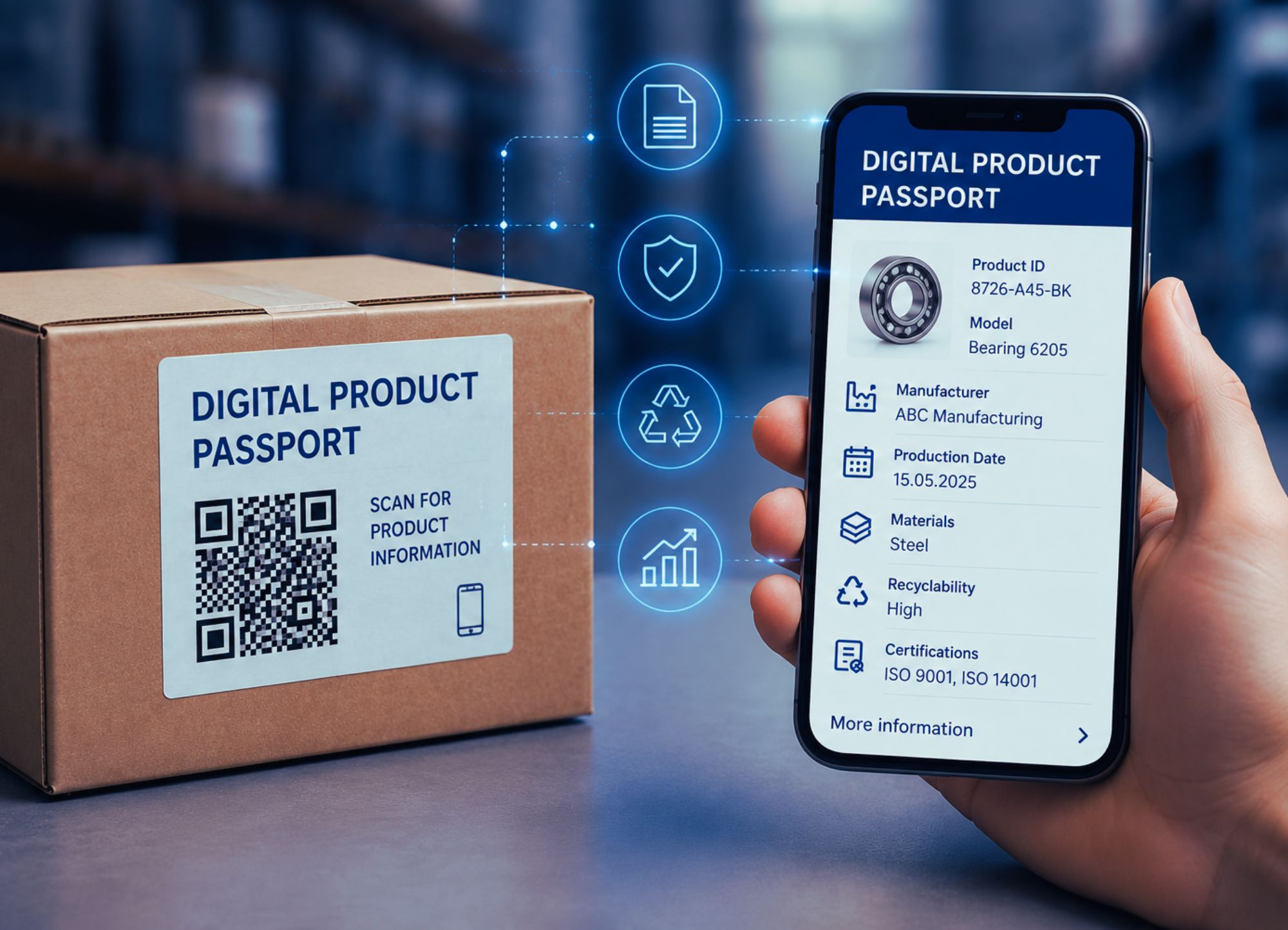
A Digital Product Passport, also known as a Digital Product Passport or DPP, can be considered a digital profile of a product. It contains structured information about its origin, composition, materials used, technical characteristics, durability, repairability, reuse or recycling capabilities.
In practice, this is a way to make important product information available in a digital format – for example, via a QR code, link or other digital medium. Depending on the applicable requirements for the respective product group, different actors in the chain – from manufacturers and suppliers to traders, control authorities and end customers – can access different amounts of information according to their role.
It is important to emphasize that the Digital Product Passport is not just an electronic label. It is a tool for managing and sharing reliable product information throughout the product's life cycle - from production and marketing to use, repair, reuse and recycling.
Why is the European Union introducing this concept?
European sustainable product policy increasingly focuses on transparency, durability, reparability and the ability of products to remain in the economic cycle longer. The aim is to reduce waste, promote more efficient use of resources and provide more reliable information to businesses, institutions and consumers.
In this context, the Digital Product Passport is emerging as one of the key tools for implementing the new European approach. Through it, product information can be more easily verified, updated and used by the different actors along the supply chain.
For businesses, this means that the topic should not be seen solely as a future administrative requirement. It is also related to the way in which companies prove the origin, quality, sustainability and compliance of their products to partners, customers and institutions.
When is the Digital Product Passport expected to be introduced?
The Digital Product Passport will not be implemented simultaneously for all products and all sectors. It is expected that the requirements will be implemented in stages, through specific rules for individual product groups.
The Ecodesign for Sustainable Products Regulation – ESPR – entered into force on 18 July 2024. It creates the framework for setting future sustainability, traceability and digital information requirements for products placed on the EU market. The European Commission has adopted a working plan for the period 2025-2030, which identifies the first priority product groups, including steel and aluminium, textiles with a focus on clothing, furniture, tyres and mattresses.
It is important to clarify that the inclusion of a given product group in the working plan does not automatically and immediately imply an obligation for all enterprises in the relevant sector. The specific requirements, including what information will be included in the product passport and when the rules will apply, will be determined by subsequent acts for the individual product groups.
This means that for many companies there is no immediate obligation to implement DPP yet. However, the preparation of product data, internal processes and digital solutions should start early, as collecting, structuring and maintaining reliable information requires organizational and technological capacity.
As an example of a more specific development in this direction, the regulation on batteries can be cited, where the introduction of a passport for certain categories of batteries is already foreseen from February 18, 2027. Although the requirements differ according to product groups, this example shows the general trend towards greater traceability, access to reliable data and provision of product information in digital format.
What does this mean for business?
The introduction of the Digital Product Passport will have different implications for different sectors and types of businesses. Manufacturers will be among the main participants in the process, as they hold much of the product information - materials, components, technical parameters, production processes and documentation.
Importers and distributors will also have a role to play, especially when the products they offer fall under specific digital product information requirements. For retailers and companies involved in repair, maintenance, reuse and recycling, access to reliable data can make their work easier and improve the quality of services.
For small and medium-sized enterprises, the topic is particularly important because preparing for DPP does not necessarily start with a large technology investment. In many cases, the first step is more practical: identifying what product information already exists, where it is stored, who maintains it, and how it can be structured in a way that meets future requirements.
Not just regulation, but also opportunity
While the Digital Product Passport is being developed in the context of the European regulatory framework, it can also be seen as an opportunity for business. Companies that maintain clear and verifiable information about their products can more easily build trust with partners and customers and participate in supply chains with higher requirements for traceability and product information.
For export-oriented companies, such preparation can be particularly important. More and more European partners, large customers and retail chains pay attention not only to price and quality, but also to the origin, composition, traceability and environmental characteristics of products.
In this sense, DPP can become part of the broader digital transformation of enterprises - related to data management, integration between internal systems, process automation, and better communication with the market.
Why is it important for businesses to follow the topic now?
The specific requirements for different product groups will be introduced in stages. This gives time for preparation, but does not mean that the topic can be postponed entirely.
Businesses can start with a few basic questions:
- What product information do we already collect and maintain?
- Where is this data stored — in documents, spreadsheets, ERP, CRM, warehouse or manufacturing system?
- Who in the organization is responsible for keeping them up to date?
- Is there information that is missing or only partially supported?
- What products or product lines would be best suited for initial analysis?
Such an approach allows businesses to prepare gradually and realistically, without unnecessary administrative burden and without hasty decisions. For many companies, the first important step will not be choosing a specific technology, but clarifying the available product data and the processes through which it is collected, verified and updated.
In the next publications in the series, the Chamber will focus on the regulatory framework, practical information for enterprises and the preparation of businesses for the phased introduction of the new requirements. Through such initiatives, the Chamber continues to support companies with timely and practically applicable information on topics important for their activities and future competitiveness.
The article was prepared with the expert assistance of Wiara - Daas Ltd – member of the Ruse Chamber of Commerce and Industry, working in the field of digital business solutions and product information management.