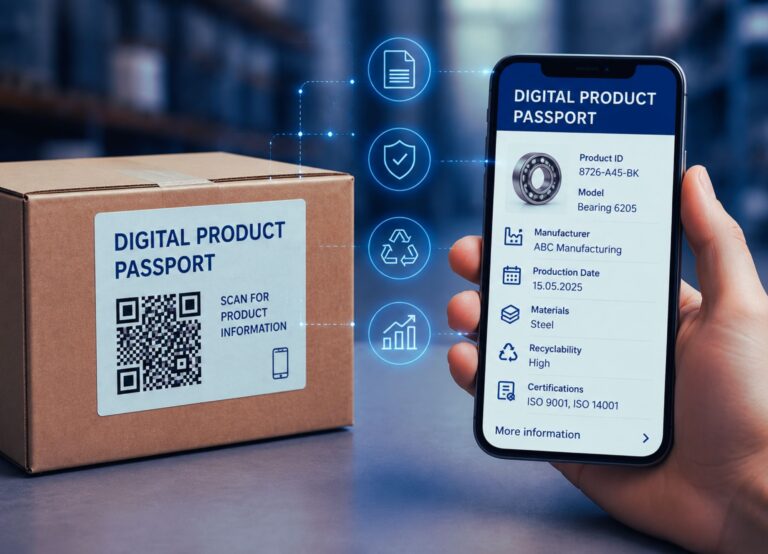

Digital Product Passport: What data should businesses prepare and where to start

The first two publications in the Ruse Chamber of Commerce and Industry information series presented the basic concept of the Digital Product Passport (DPP) and the regulatory framework in which it will develop. The next practical question for businesses is what product information will be needed and where can businesses start their preparations.
The topic is important because the Digital Product Passport is not just a technological solution or an electronic label. It is based on the availability of reliable, structured and up-to-date product data. It is the quality of this data that will determine how well a company can meet future requirements and provide information in a way that is useful for partners, customers, institutions and other participants in the chain.
Why product data is at the heart of DPP
The Digital Product Passport aims to link a physical product to verifiable digital information about it. Depending on the specific product group, this information can be related to origin, composition, materials, technical characteristics, durability, repair, reuse, recycling, safety and compliance with applicable requirements.
It is important to emphasize that there is no single universal list of data that is applicable to all products. The specific content of the passport will be determined step by step through subsequent acts for individual product groups. This means that the requirements for textiles, batteries, furniture, tires or electronic equipment will not be the same.
However, businesses can start preparing even before all the specific rules are adopted. The first step is not choosing a platform or placing a QR code, but clarifying the product information the company already has.
What categories of data are good to review?
At this stage, it is useful for businesses to review the main categories of product data that may be relevant for a future Digital Product Passport implementation. These should not be seen as a definitive list of mandatory requirements, but as a practical guide for preparation.
| Data category | Examples of information |
| Identification and responsibility | model, series, article number, batch, code, version, manufacturer, importer, distributor or other responsible economic operator |
| Composition and origin | materials used, components, main raw materials, origin of materials or components, content of recycled materials |
| Sustainability and life cycle | durability, repairability, maintenance, reusability, recycling, disassembly, end-of-life treatment |
| Compliance and documentation | technical characteristics, instructions for use and safety, declarations, certificates, test reports, information on substances of concern, environmental characteristics or carbon footprint, where applicable |
Not every company will have all of this data, and not every category will be applicable to every product. The practical value of such an overview is to show where information already exists, where it is missing, and which data depends on suppliers, partners, or external documents.
Where is product data usually located?
In many companies, product information already exists, but is distributed across different departments, documents and systems. Some of it can be found in technical specifications, offers, certificates, declarations of conformity, invoices, warehouse systems, ERP solutions, spreadsheets, product catalogs, labels, instructions or communication with suppliers.
This creates a practical problem: the information may be available, but not structured in a way that allows for easy verification, updating and sharing. When introducing a Digital Product Passport, it is this organization of data that will be of key importance.
Therefore, preparation should begin with an internal review. Companies can establish:
- what data is already being collected for each product or product line;
- in what format are they stored;
- which department or employee is responsible for them;
- how often they are updated;
- which data is received from suppliers;
- which documents prove compliance or technical characteristics;
- Is there a discrepancy between information in different systems and documents?.
Such an overview helps the enterprise see not only what it has, but also how much it can rely on this data in future requirements for digital presentation of product information.
The role of suppliers and partners
The digital product passport focuses not only on information that is created within a company, but also on data that comes from the supply chain. For many products, the manufacturer or retailer does not have all the necessary information on materials, components, origin, composition or conformity on their own.
Therefore, one of the early steps is to review what information is required from suppliers and in what format it is received. For some companies, this may mean updating supplier questionnaires, reviewing contract clauses, collecting certifications, or introducing clearer requirements for documentation that accompanies deliveries.
This process is especially important for companies that operate in international supply chains, use different materials and components, or sell products to more demanding markets. The earlier information gaps are identified, the more realistic the preparation can be planned.
Where to start a business?
Preparing for a Digital Product Passport can begin with a few practical and manageable steps, without the need for the company to immediately implement a complex technological system.
- Product line selection
A company can start with a single product line or group of products that are important to its business, have export potential, or may fall within the scope of future regulations. This allows the process to begin with a limited and realistic scope. - View available data
It is a good idea to make a list of available product data. The goal is to identify what information already exists and where it is located – in documents, spreadsheets, technical files, ERP system, warehouse system, product catalogs or with suppliers. - Identifying gaps
It should be determined what information is missing or incomplete. This may include data on materials, components, current certificates, technical documentation or a clearly defined person responsible for maintaining the information. - Designation of responsible persons
Preparing for DPP is not the task of just one department. It may require the involvement of manufacturing, quality control, procurement, sales, logistics, sustainability, IT, and management. - Structuring information
The company can start organizing information in a more structured way. This does not necessarily mean immediately implementing a new system. In the beginning, it may be enough to create an internal template, a map of the available data, or a table that shows what information is available, who maintains it, and what documents prove it.
What questions should businesses ask themselves?
To make an initial assessment of their readiness, companies can start with a few questions:
- Do we have a clear list of the products and product lines we offer?
- Can we link each product to specific technical documentation?
- Do we know which materials and components are used in our main products?
- Do we have up-to-date compliance documents, certificates or test reports?
- Where is the product data stored and who updates it?
- How much of the information depends on suppliers?
- Is there data that is only maintained in emails, spreadsheets, or separate documents?
- Can we quickly provide reliable product information when requested by a customer, partner, or institution?
The answers to these questions can show how prepared the company is for future requirements and where the main organizational or information gaps are.
Data as part of competitiveness
Preparing for a Digital Product Passport should not be seen solely as a future regulatory obligation. For many businesses, better management of product information can also have direct business value.
Structured and reliable data facilitates communication with customers, partners and suppliers. It supports sales, technical support, quality control, export preparation and participation in supply chains where traceability and sustainability requirements are gradually increasing.
Companies that can quickly and clearly provide information about their products will be in a better position to meet future requirements and market expectations. In this sense, DPP is not just a regulatory topic, but part of the broader process of digitization and professional data management in enterprises.
Useful official sources
More information about the regulatory framework and the approach to product data can be found in the following official sources:
· Regulation (EU) 2024/1781 on Ecodesign for Sustainable Products /ESPR/
· European Commission information on the Digital Product Passport
· EC Joint Research Centre methodology for defining data requirements in DPP
· Regulation (EU) 2023/1542 on batteries and waste batteries
Looking ahead
The digital product passport will develop in stages, but the preparation for it starts with something relatively practical: better understanding and managing product data. For businesses, this means reviewing available information, identifying gaps, and building clearer internal processes for collecting, verifying, and updating data.
In the next posts in the series, RTIK will look at which sectors will be most affected, how the Digital Product Passport works in practice, and how small and medium-sized enterprises can approach their preparations in a phased and realistic manner.
This material is part of the RTIK information series on the Digital Product Passport and business preparation. The publication was prepared with the expert assistance of Wiara - Daas Ltd – member of the Ruse Chamber of Commerce and Industry, working in the field of digital business solutions and product information management.